AI writes production code now. Not always correct code, not always secure code - but code that ships. If you're evaluating how to build software in 2026, whether in-house or through a partner, that fact changes the conversation more than any framework trend or cloud migration pitch.
The teams pulling ahead aren't the ones with the biggest budgets. They're the ones who've figured out where AI adds genuine speed and where it quietly introduces risk.
What does modern software development actually involve?
Software development means turning a business requirement into working, maintainable technology - and then keeping it working as requirements change. That definition sounds simple. The execution isn't.
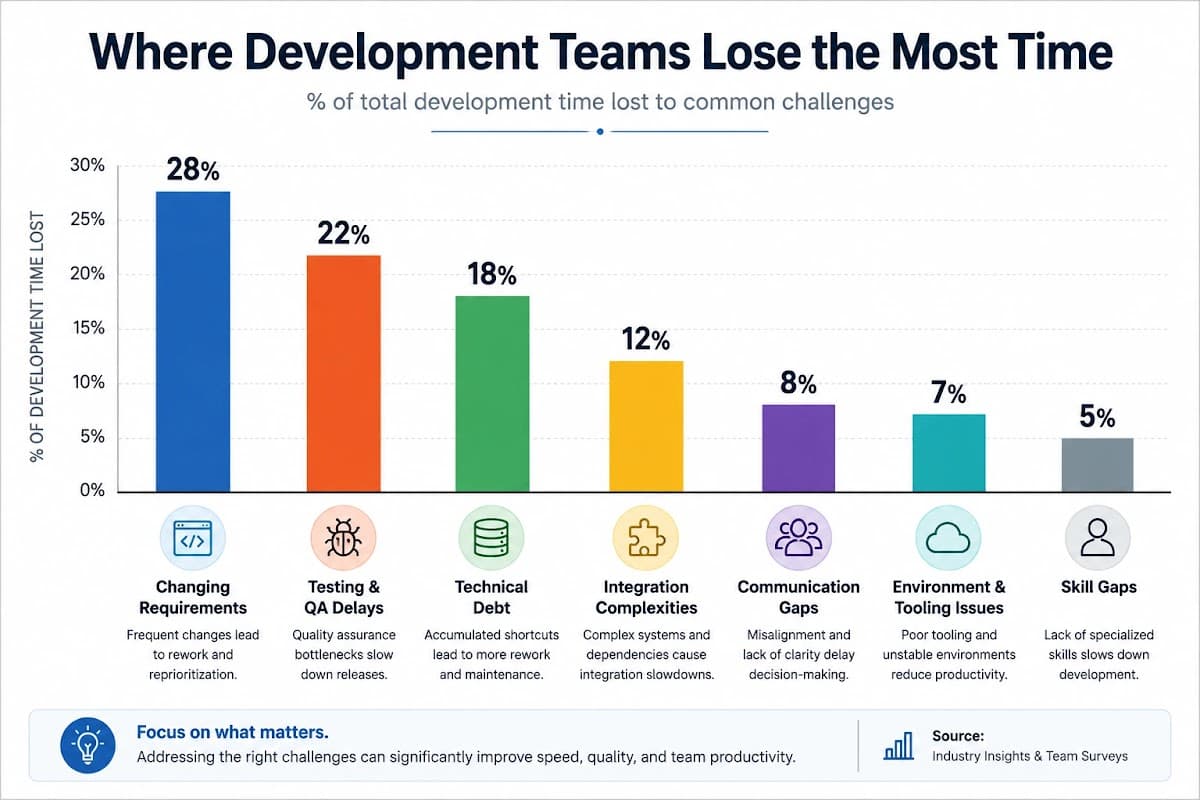
A full-cycle engagement covers product discovery, system architecture, front-end and back-end engineering, API development, testing, deployment, and ongoing maintenance. Each phase has its own failure modes. Most project overruns trace back to gaps between the planning phase and the build - not bad engineers, but unclear scope handed to capable people.
The discipline that holds it together is engineering rigour: version control, code review, automated testing, and a deployment process that doesn't require a prayer. Software development done well is invisible to end users. Done poorly, it becomes the reason your product can't scale past 10,000 users or integrate with anything built after 2018.
How is AI changing software engineering in 2026?
The most immediate change is in developer productivity. AI coding tools now handle boilerplate generation, test scaffolding, and repetitive refactoring - work that consumed real hours on every sprint. Independent studies put productivity gains at 30–55% on contained tasks. That's not a rounding error.
But agentic AI development is the shift worth watching closely. Agentic systems don't just autocomplete - they plan multi-step tasks, call APIs, write and run tests, and iterate on output without constant human prompting. LLM application development and RAG-based architectures are already in production at companies that were experimenting with them 18 months ago. The gap between early adopters and everyone else is widening.
The risk is equally real. AI-generated code can be syntactically correct and logically broken. It can introduce security vulnerabilities that pass a basic review. Any AI software development engagement that doesn't include rigorous QA automation and human architectural oversight is cutting corners in the one place you can't afford to.
What should you look for in a custom software development company?
Three things that most vendor evaluations underweight:
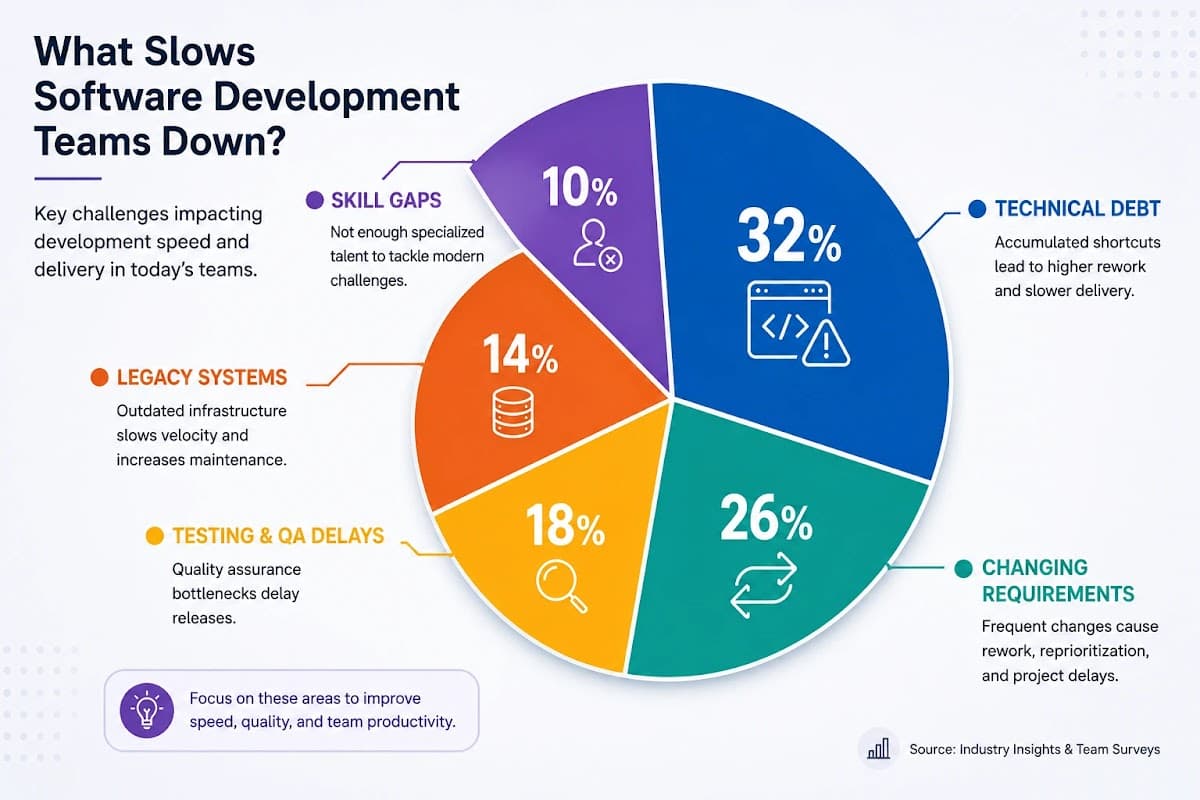
- Architectural thinking, not just delivery speed. A custom software development company that leads with "fast delivery" is selling you the wrong thing. Fast delivery of the wrong architecture creates technical debt that costs more to unwind than the original project. Ask to see how they handle scope changes mid-build. That's where architecture gets tested.
- AI integration capability, not just AI marketing. The difference between a company that uses AI tools internally and one that can build AI-powered products for you is significant. Enterprise AI implementation requires understanding of model selection, data pipeline design, MLOps, and responsible deployment - not just prompt engineering. Ask specifically what AI and machine learning development work they've shipped to production.
- Engagement model fit. A dedicated software development team embedded in your workflow operates differently from a project-based vendor. For long-term product work - SaaS development, enterprise application development, digital transformation programmes - a dedicated team model typically outperforms fixed-scope contracting. For defined, bounded projects, the reverse can be true.
Why are India-based software development companies worth serious consideration?
India's position in global technology consulting isn't about cost alone - though the economics are real. Enterprise software development companies in India, particularly in Mumbai, Gurgaon, and Bangalore, have spent two decades building delivery capability for demanding global clients. The maturity shows in process: most established firms run certified agile methodology practices, maintain ISO or CMMI compliance, and have navigated enough failed offshore relationships to know what makes them fail.
The meaningful differentiator now is AI capability. The firms investing in agentic AI development, generative AI software solutions, and genuine machine learning development - not just wrapping GPT-4 in a UI - are operating at a level that competes with any market globally. Software development outsourcing services have evolved; the question is whether the company you're evaluating has evolved with them.
For startups and mid-market companies that can't justify a full internal engineering team, a software development company in India with a strong AI and cloud computing practice offers a credible path to enterprise-grade product development at a fraction of the cost of equivalent US or UK capacity.
What does end-to-end software development services actually mean?
It means a single partner owns the full product lifecycle - from discovery and architecture through build, QA, deployment, and post-launch iteration. No handoffs between a strategy firm, a dev shop, and a separate DevOps consulting team. No gaps in accountability.
For complex products - custom CRM software, enterprise application integration, cloud-based software development across multiple services - fragmented ownership is a structural risk. One team that understands your system end-to-end can make better tradeoffs than three teams optimising for their own scope.
The best digital product engineering engagements feel less like outsourcing and more like extending your internal team with people who've solved similar problems before.
How do you evaluate software development pricing honestly?
Custom software development pricing varies widely, and most published ranges are too broad to be useful. A 5-screen mobile application and a multi-tenant SaaS platform are both "custom software" - they don't belong in the same pricing conversation.
What drives cost: complexity of integrations, number of user roles and permission layers, real-time data requirements, regulatory compliance (HIPAA, GDPR, SOC 2), and the level of AI capability built in. A rough benchmark: a well-scoped MVP from a credible custom software development company in India runs $25,000–$80,000. The same scope with a US-based agency typically runs 2.5–4x higher.
Get a detailed technical scope before any pricing conversation. A vendor who quotes without scoping is guessing - and you'll pay for the gap.